Jrp Ringier in Zurich published the short text The two rooms, that was proposed as a literary interpretation of the Kafka's story "Investigations of a dog", written in 1922 and published in 1931 after the author's death. In Kafka's story "the unnamed narrator, a dog, recounts a number of episodes from its past, in which it used quasi-scientific and rational methods to resolve basic questions of its existence that most of its peers were content to leave unanswered, such as: "Whence does the Earth procure its food?".

Many of the seemingly absurd descriptions employed by the narrator express its misapprehension or confusion about the world, centering on dogkind's apparent inability to realize (or, some passages suggest, unwillingness to acknowledge) the existence of their human masters". The rational dog's thoughts and the impossibility to refuse their rational basis (even if the text shows the impasses they are driving to) relate this investigations to any vain, human effort to conclude about reality through thinking.
The "two rooms booklet" consists of a response to the Kafka's novel that insists at an oposite attitude of beings to keep doing things without investigation. Another most trivial aspect of animality is linked to the condition of tribe and its absurdities. The text is published in Greek.
 The same editor published the Atlas of Transformation. The thick book is a publication prepared by Tranzit Display, Prague for the project Monument to Transformation. It is a collection of entries that capture transformation in the recent european history. The book is proposed as a dictionary containing also art reproductions and sketches.
The publication counts already two important design prizes: the one of Most Beautiful Swiss Books, Zurich 2011 and the Best Book Design from all over the World, Leipzig 2011. Its graphic design is signed by Adéla Svobodová. The volume contains entries by Adam Mazur, Adéla Gjuričová, Agela Detanico, Rafael Lain, Alexander Gerner, Alexander Kiossev, Alexei Penzin, Ana Janevski, Ana Paula Cohen, Anatolij Osmolovskij, Andrej Lankov, Aristide Antonas, Artem Magun, Ayreen Anastas, René Gabri, Babi Badalov, Beatriz Herraez ,Boris Buden, Boris Groys, Boris Ondreička, Cabello/Carceller, Cristián Gómez Moya, David Chioni Moore, David Kulhánek, Egon Bondy, Eileen Legaspi-Ramirez, Erick Beltrán, Ernest Gellner, Fang Hu, Fedor Blaščák, François Piron, Françoise Mayer, Franz Kafka, Frederic Jameson, Frederic Jameson, Georges Perec, Gilles Deleuze, Pierre-Félix Guattari, Haegue Yang, Hakim Bey, Homi K. Bhabha , Hrach Bayadyan, Chantal Mouffe, Igor Zabel, Ilja Kabakov, Jacques Rupnik, Jaime Iregui, Jens Kastner, Jeong Hwan Joe,Ji Yoon Moon, Jiří Havel, Jiří Přibáň, Jiří Suk, Joanna Erbel, Joaõ Maria Gusmaõ, Pedro Paiva, Joaquín Barriendos Rodríguez, Julia Moritz, Juliane Debeusscher, Karel Kosík, Karl Holmqvist, Karl Lydén, Kārlis Račevskis, Keiko Sei, Keti Chukhrov, Kostis Stafilakis, Lásló Csaba,Leszek Balcerowicz, Lia Perjovschi, Livia Pancu, Raluca Voinea, Magdalena Ziółkowska, Marcel Tomášek, Marco Scotini, Mariano García, Marina Gržinić, Martin Škabraha, Mikołaj Lewicki, Milan Otáhal, Milan Šimečka, Milan Zelený, Miroslav Petříček, Mladen Stilinović, Nataša Petrešin-Bachelez, Nerea Calvillo, Ninotchka Rosca, Pavel Barša, Primož Krašovec, Radim Marada, Raluca Voinea, Raqs Media Collective, Rastko Močnik, Ricardo Basbaum, Sergio Rubira, Slavoj Žižek, Srdjan Jovanović Weiss, Svetlana Boym, Teresa Riccardi,Timothy Garton Ash, Tomáš Pospiszyl, Tomislav Z. Longinović, Václav Bělohradský, Vangelis Vlahos,Vassilis Vamvakas, Viktor Misiano, Vlad Morariu. Yannis Stavrakakis, Yelena Vorobyeva,Viktor Vorobyev, Zbyněk Baladrán, Zdeněk Košek, Zdislav Šulc. The chief editors are Zbyněk Baladrán and Vít Havránek. The project direction was done by Věra Krejčová.
The house for doing nothing
The Žižek residence is proposed more as a call for discussion about architecture and politics today than as a specific design concerning a small house or a complex of houses in an isolated Greek island. The house answers one of Žižek's quest for withdrawal but in the same time it seeks a way to reenter a political discourse. A possible Greek architectonic example is elaborated today within Greece's controlled bankruptcy, following the Slovenian theorist's consultation. Žižek writes in his Violence book (Picador, 2008):
“A critical analysis of the present global constellation- one which offers no clear solution, no "practical" advice on what to do, and provides no light at the end of the tunnel, since one is well aware that this light might belong to a train crashing towards us-usually meets with reproach: "Do you mean we should do nothing? Just sit and wait?" One should gather the courage to answer: "YES, precisely that!" There are situations when the only truly "practical" thing to do is to resist the temptation to engage immediately and to "wait and see" by means of a patient, critical analysis. Engagement seems to exert its pressure on us from all directions. In a well-known passage from his Existentialism and Humanism, Sartre deployed the dilemma of a young man in France in 1942, torn between the duty to help his lone, ill mother and the duty to enter the Resistance and fight the Germans; Sartre's point is, of course, that there is no a priori answer to this dilemma. The young man needs to make a decision grounded only in his own abyssal freedom and assume full responsibility for it.
An obscene third way out of the dilemma would have been to advise the young man to tell his mother that he will join the Resistance, and to tell his Resistance friends that he will take care of his mother, while, in reality, withdrawing to a secluded place and studying...”
Nevertheless the character of the Žižek residence even if it is proposed as a place for withdrawal may finally refer to a permanent, voluntary isolation. The Slovenian thinker proposes some distance from the world (a strategy that would "resist the temptation to engage immediately", a proposal to “wait and see” and have the opportunity for "a patient, critical analysis" after the voluntary withdrawal); nevertheless the house shows that, in some cases, the option of stepping back in order to have a distance from society is already problematic from its nowadays setting. The house is of course proposed as a place of literal withdrawal: in the same time, (and I am formulating here already my answer to Léopold Lambert) nothing seems to promise that there is a possible return to the condition that the house declines. The negation of society that the house proposes is in the same time constructing a new community order. The condition of the Žižek's house creates, while it is introduced as a process of withdrawal, different layers of impossibilities to escape the new social platforms that have already moved into the house, (not only in this exotic residence but in many houses) some years ago. The particular manner of withdrawing the house proposes already organizes an intermediate state, structured in between the absolute private sphere and the public function that melt in the inhabitation of the Internet. If we understand seclusion as a step back to the private, then we may agree that what was normally understood as a step back strategy yesterday does not apply today: no way out of this area seems possible. The house is designed as a confinement place, chosen deliberately. Žižek supposes that a "wait and see" strategy may promise anew a political future. But does his opinion present a possible way to invest upon the role of thinking today? Can we save the process of thinking by investing again in the same concept that made it valuable in the western past? The world theory (θεωρία) in ancient Greek describes a way to understand reality from a distance, the way to contemplate things from while we are distant to them in a way that we cannot touch them. The theoretical aspect of reality is related to the possibility of viewing from a distance. This distance that is necessary for a theoretical thought seems difficult for the nowadays Žižek's "withdrawal hero". The way the humankind (in its global north version) relates to its present through the inhabitation of the "Internet living archive" needs an analysis that would invest to the affirmation of the impossibility of distance. It seems that what Žižek presents as the precondition for any serious political position describes also a structural impossibility for the place of withdrawal today to create a distant look. We request a distance from things, we schedule a house in order to obtain this result but this house only shows the impossibility of the scheduled distance. The meaning of "wait and see" strategies is -in this background- ambiguous. The cancelation comes together with the project. Does Žižek mean that after some "images of a changing world" are formed and after some "political thinking" is performed, we could be able to return to the world or at least judge about its problems, propose possible ways to treat the problems in a pensive way? Or does he suggest that this distance is a prerequisite for any intellectual operation? In both cases this house organizes the distance from things as an impossible construction, in many senses: its interior space is produced as an idiosyncratic impossibility of distance that rules any political question concerning the global north. The Žižek's house is a counter project in its "first" reading: it proposes the negation of Žižek's idea; the glorification of withdrawal in the post network society of the global north may propose a problematic task, not because such a strategy is necessarily wrong but because the possibility of creating a condition of withdrawal seems complex today.
The attitude described by Žižek is not determined uniquely by the refusal of commitment to the community: there are many ways for doing nothing. We can retire to refuges in different ways. The withdrawal should not be seen as a political attitude per se but already in its political context. We recall three literary heroes of withdrawal. The first shows a different way to conceive “doing nothing”, in antithesis with the hero of Žižek. Jean Jacques Rousseau describes himself in his Rêveries du promeneur solitaire in a happy condition of isolation, in the almost deserted island of Saint Pierre that some call "l’île de la Motte". Rousseau locates a kind of happiness on his isolation days on the island. “Far niente”, the inactivity of this period is the biggest pleasure he experienced, present in all its sweetness. Devoted to inaction, he could not hold any communication or correspondence, and yet this period is described by Rousseau with great nostalgia. The inertia of his voluntary exile to a place where the author is hiding safely offer delight and a distance from community matters. While the withdrawal is described as enjoyable, it cannot be associated with any technique of responsibility of a political philosopher. Rousseau does not expect the distance to help him recognize new common problems or investigate anew about politics. He lives on the island in order to avoid the community which is presented as a menace and he enjoys this pause of the community life as a happy, early death that makes the hero’s problems disappear. Žižek's hero is not a hero of the “far niente” neither is he negating the community.
The second "withdrawal hero" would be Ivan Gkontsarov’s Oblomov, described in the novel that bears the hero’s name, published in 1850. Within the narrative we meet Ilia Illich Oblomov, a young nobleman, unable to take important decisions or undertake any significant actions. In the evolution of the novel he rarely leaves his room or bed: he stays in bed for the first hundred pages of the text. The book was considered as satirizing the noble class whose social and economic situation seemed problematic in the mid 19th century in Russia. Some laziness or inactivity, a reference to laziness was an important feature of the Oblomof’s withdrawal. And yet no laziness would characterize the Žižek’s "withdrawal hero" within the “living archive of the Internet”. The "pause for reflection" that forms Žižek’s hero has nothing to do neither with a hero of laziness nor with an emplematized hero who consciously refuses of work, as proposed, for example, by Paul Lafargues in his Right to Be Lazy. Labor today is structured differently than in the past. Labor through the Internet often diminishes the importance of spatial factors, it disturbs the oposition between working space and residence. As noted by Negri, labor tends to be determined by an immaterial condition. Franco Berardi also notes that labor is increasingly depending on cognitive functions. The immaterial labor of cognitive functions detaches the working man from the workplace. The work may occur indoors, within the space of withdrawal. The Žižek’s "withdrawal hero" in the present condition may be a normal working human.
The third "withdrawal hero" is the Des Esseintes coming out of the novel À rebours (Against the Grain or Against Nature) of Joris-Karl Huysmans. Des Esseintes decides to retire and devote his life in rest and in intellectual and aesthetic pursuits. Des Esseintes is presented as an eccentric, reclusive aesthete and Antihero: he dislikes the bourgeois society of the 19th century and attempts to withdraw into the world of art and the work of his own creations. In the last lines of the novel Huysmans compare the hero's "return to human society to that of a nonbeliever trying to emrace religion". The community appears impossible after the withdrawal. The hero of the house for doing nothing meets necessarily with the community since his withdrawal is radically transformed from the setting of its rules.
The hermit condition in the case of intellectuals to whom we turn our attention today is described through an impossible destination. Firstly, the Žižek’s hero cannot find a “correct” place "outside the community." We do not control even the meanings of such a concept today. Secondly the Ziek’s "withdrawal hero" cannot form the "external perception" as is required by hypothesis : he is defined by a lack of exteriority. Žižek's hero is the hero of impossible withdrawal because he lives in the area where the private became blurred with the public.
Withdrawal is either an impossible task or a necessary condition for the creation of the nowadays community. Léopold asks about the ephemeral character of Žižek's house as a seclusive place: a possible return "back there" may be very impressive. Nevertheless I am very skeptical about the character of this glorious return. The most important factor, in the design of this house would be that (from a particular point of view) it shows a voluntary confinement place. Nothing seems wrong in the withdrawal it organizes since it is performed as a voluntary entrance into an invisible community. Between a person and the community there is no clear limit, if we consider a person as a user of platforms and the community as a function of answering to given protocols or rearranging archive entries. From this point of view a political thinking would have to consider a future of politics in the archive.
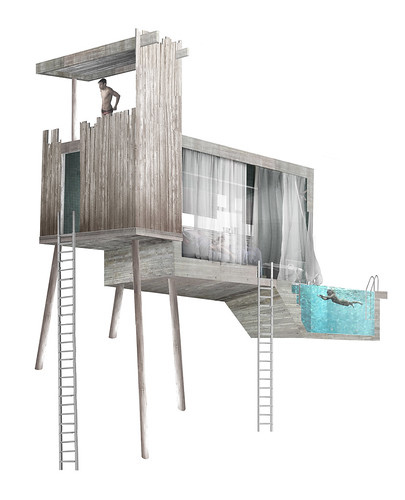
The tower of Babel and the open dispersed agora / The system of interpreting a text today may take under consideration the conditions in which any interpretation is performed. We are used to meet people through texts, through tags, through invisible communities and we are also used to see people gathered around images. Discussion in this condition (as a possibility of any transaction between personal computers) forms an always open space; nevertheless, a discussion paradise of an open dispersed agora (that Ethel Baraona Pohl mentions in her post about the Žižek’s house) can also be described as a Babel tower of the common. None of those two different interpretations of the Žižek’s house architecture is privileged. We cannot argue that the Internet proposes a dispersed agora without adding that this agora is not exactly formed as a system of discussion but as a system that always already archives the discussion it generates, proposes its results as partial views, stores them over other similar, and finally makes them difficult to confront. Political decisions in this background can mainly be engagement strategies similar to the ones Žižek refuses in order to withdraw. The Internet discussions are by definition flexible left-overs like the one we are producing now together with Ethel and Leopold, using a foreign language that we all three cannot handle without difficulties. We cannot say neither that the Internet is a contemporary Babel, we cannot demonize it without adding that there are those characteristics of the Internet that can fix open platforms where everything can be posted, rarely in the form of discussion (as it happens now after we settled a chosen scenography). This negation to conclude about Internet, (to refuse to judge if it is a terrible thing and neither consider it represents the heaven of an open agora) is a prerequisite acceptance for reading the Žižek’s house project. Architecture in the condition of the Internet is not simply the creator of a "physical", "empirically experienced" environment; we would reduce the power of architecture if we only conceive it as a function of a "stable, existing" environment. Architecture today is a word to describe the complex systems that form backgrounds for human actions. Architecture would have then to be shaped as a coordination of both sides of the living areas: from one side the "empirical living of the real space" and from the other side, a living that investigates and perform in another interior space where we undertake actions through the web; specifically by answering to the web's different platforms. Does this design of Žižek’s house handle the totality of the matters, posed through such a wide investigation? It cannot. The design can only give form to a wide cockpit. It proposes the inhabitation of a cockpit with a particular relation to the materiality of a culture that understands the human body as a remain of a visual civilization. The uneasiness of such a relationship of space to the human body is also to be treated by the design of the house. Can we think about a cockpit as a place that has a reason "per se" to exist, without taking account of the destinations where it leads us? A cockpit is always a place that has prepared the conditions of a flight; what if this flight becomes the norm of the user? The cockpit becomes then a necessary condition of an unavoidable body, a space that treats the body functions as the excrement of the network activities. We only see in the house the remains of an intellectual life that is rendered invisible through a constant presence in the web. The Žižek’s house undertakes the role of interpreting a provocative fragment of an essay. It does so by unifying the two pieces of the user's experience, the life in the web and the life out of it. The house was always a space of a pause, installing a rupture in the time of the community. It represented an exit from the community. The Žižek’s house is no longer conceived as a space of a pause. The pause is not to be inhabited any more. The pause may be now an exit of the house, an exit of the net. The pause may be a necessary return to the old concept of the world. This would be the new exotic of tomorrow. Inhabiting the house is here identified to an idiosyncratic seclusion in the invisible communal space in which infrastructure, labor, entertainment, community networks and intellectual contemplations are melted in a unified sphere. The house is conceived as the mere ground of this sphere. It may sound normal that if we follow Žižek’s exhortation for "doing nothing" we may return home. Nevertheless today's homes for the humans living in the global north are not such places. If the "withdrawal hero" does not accept this kind of place as a secluded place for studying, what other possibilities could he have? If the Žižek’s house is replaced from a primitive cave or a unconnected spot, its resident will not be able to contemplate an important part of the society; in the same time the Žižek’s hero will be unable to judge about a changing society or perform any political investigation concerning it.
Stepping back is not exactly the condition that negates the networks. It is the function that the network needs in order to be created. While the limit between the network and its outer space is problematic, the question of political intellectual awareness seems also changed. The system of interpreting today's "home culture" could include discussions founded on net communities, performed through particular platforms that in the same time take advantage of the role of images. (I read here critically Richard Sennett: I do not think that the new home culture is necessarily linked to a decline of the political. A new political may be born from the conditions of the Internet) The question would be if it would be productive for future discussions to propose built environments as this "house for doing nothing", entering with rush into fields that show quick realizations of hidden intentions. The Žižek's text can be elaborated in order to conclude into an architecture. This architecture is, from one point of view, evident, through the plans and the images that describe it, and from another point of view the same architecture cannot be anything without an internet discussion concerning it. Three users write each other about their everyday experiences while they look in this idealized seclusion place. What is exotic in this easy communication? From a certain point of view the present discussion shows that the citizens of the global north are always already in Žižek's house condition: they are defined by similar settings.
Inaction/ This project undertakes to extend an investigation on inaction; the "raison d'etre" of Žižek's apartment is due to some nowadays modes of inaction. A cynical description of the city after the substitution of many of its functions through the Internet is a prerequisite for this investigation. The notion of political responsibility cannot be the same as before; a gap may interrupt its history. The changes in the concept of identity and its new definitions through the idea of "presence in the web" will determine this new phase of responsibility. If we understand the new possible cities as populations of secluded refuges that may look like congregations of well equipped, networked computer spots, we may need new descriptions of citizenship and of the communities that could replace the urban conditions of the past. The theoretical tradition of responsibility (as epitomized for instance in Levinas' or in late Derrida's works) gives an account of the preconceptions of philosophical thinking needed for the formalization of a political attitude within a community: an interesting part of this philosophical bibliography concerning "responsibility" was projected towards political theory. This theoretical past would need re-elaborations; remodeling the concept of responsibility and rejecting part of its tradition are related to the condition that the Žižek's house. The "house for doing nothing", also proposed as "the responsible house", is published in order to formulate a complex question concerning an attitude that does concern mainly a response to "not real things", a particular engagement to "entries that describe absent things" without needing the reference to any "prototypes". How can we think about responsibility with a new broken concept of identity that does not correspond to the civic identity, with no signature charged for the responsibility of the evolution of things, with a poor world populated by things and a rich world determined by an accumulation of conscious representations.
Difficulty to be patient and theorize / It is structurally difficult to ask for a "patient, critical analysis" of the situation we live in nowadays for three reasons at least. From a first point of view: the wind of global social changes poses practical problems regarding this need of deceleration; in a battlefield, in an open procedure of undetermined fights there is usually no time to install thoughtful distances from facts, especially in the case that rapid changes occur; we do not have the luxury for the necessary step back that could permit any intellectual preparation of thoughtful actions. This first argument is of course similar to the banal proposition that Žižek tries to avoid. Nevertheless let's consider that this position has a right to exist today: it is difficult to avoid the urgency of the evolving situations by a mere negation of them; we have a good example here in Greece. From a second point of view the imposed distance is formed through an idiosyncratic image of the exterior space that tends to be identified to an interior: a series of platforms can represent the exterior space, before it is posed as a problem of representation. The exterior space was conceived as a problem of representation. Today, exteriority is formed as a series of different representations. The networked civilization forms individuals who cannot really get out there, they are not supposed to question unformed fields; in this sense the users of the Žižek's house cannot reach any possible exteriority. They experience a phenomenon similar to the Plato's Cave of his Republic but seen now as an inversion: the cave has no exterior space. The most radical exteriority today is produced as a construction of the "unseen": some archived schemata, some digital landscapes soon visitable through the Internet form its matter. The distance from reality seems to produce the conscious, common and permanent core of the experience of reality "per se". Reality in this condition seems to be an always consciously distant, already represented world.
From a third point of view a "patient, critical analysis" of the situation we live in nowadays conditions would also be difficult because we would need a concrete place with the characteristics that Žižek needs in order to construct the political attitude of a thinker. The neutrality of a house of yesterday is not possible in our residences today. Maybe space lose its privilege of hosting political action within this condition; political actions may not happen any more in the world we traditionally form as architects. But where would then be this political observation place? Where would be this society we cannot configure? If a political attitude has to be formed through the elaboration of a distant view, the lack of distinction between distance and proximity could pose structural problems to its performance. At least this would mean that when we design the house for the "withdrawal hero", we do not consider his political action performed in the correct place; such a place does not exist; we will not expect to see his action deployed there nor in any other "pragmatic environment"; it may be performed elsewhere; we can neither configure the observation point from which the task of observing may be practiced; we neither see the exact target of such an observation. If thinking can still address political matters, it is at least rendered problematic in the condition of withdrawal: it cannot happen if the structure of it includes the confusion between figure and background, between the user and the community; or it may happen in a different format taking account of this other type of inhabitation of "the common" we experience. Thinking cannot be performed in a field of predetermined schemata. Thinking is read for Žižek as an abstention from the "real society" even if "the society itself" lost its meaning in various ways through the last decades. A consciousness concerning the loss of "society structures" is the most intimate core for the fabric of the Internet society "itself". A barbarism may prevail in the first possible future of a multiple, thoughtless "platform making". "Exteriority" is its first important loss. "Exteriority" in this background can only be proposed through the image of a battle field or in terms of a video game. Thinking loses its meaning whilst there is no image or visible narrative proved valuable as a representation for it in this new condition. Thinking as a nowadays human act has no convincing imagery, no slogan, its future depends to inventive graphic strategies. The civilization of writing in the form that we know it may be in "another last phase". What this loss of meaning for thinking would inaugurate? Why do we miss already the rational elaboration of western sociality so quickly and anew, after some centuries that a society of organized rationality was a western civilization target? We may propose answers to this difficult question before we undertake judgments concerning theory and action. What would be the meaning of theory today? What would be a theory without truth? If the concept of "inhabited platform" may be the analog of a city apartment, and if a congregation of platforms may already form invisible cities where every one is already leaving, who is really the actor of these new environment? Who is the actor of this house for doing nothing? The hero of the Žižek's house would be a time function, inhabiting different platforms. The actor is not a simple user but a serial, multiple "person" constructed out of an accumulation of participations in different Internet platforms.
Heterotopia / Ethel proposed the concept of hetero-topia to regulate an investigation about the house for doing nothing and the inhabitant. It is true that in the Foucault's text and in the bibliography that is linked to it, many thematic areas linked to the Žižek's house are present. Ethel insists on Foucault's “fifth principle”, where "he describes heterotopias as a system of opening and closing that both isolates ... and makes ... penetrable" the spaces that constitute them; it is true that such a description seems to be very suitable for Žižek's house. In the same time we have to do another structural remark of some importance, concerning the social field and the place of heterotopia inside it. We may put it this way, by a necessary simplification: Foucault's description of some heterotopic places is interesting because he compares some privileged or sacred places to some dreadful institutions of western modern societies. "Privileged or sacred or forbidden places, reserved for individuals who are, in relation to society and to the human environment in which they live, in a state of crisis" are compared with some "heterotopias of deviation" : the spaces for adolescents, menstruating women, pregnant women, the elderly" are compared with "rest homes and psychiatric hospitals, and of course prisons, and ... retirement homes" inscribed in a field of the heterotopic side of modern life. A crucial characteristic of heterotopias is linked to a rupture that distinguishes them as isolated places, cut from the everyday life. They do not perform within the everyday flow of time that any society tries to prove as the core of its normality; they occur within the excluded heterochrony of exception. We may quote Foucault:
"Heterotopias are most often linked to slices in time - which is to say that they open onto what might be termed, for the sake of symmetry, heterochronies. The heterotopia begins to function at full capacity when men arrive at a sort of absolute break with their traditional time. This situation shows us that the cemetery is indeed a highly heterotopic place since, for the individual, the cemetery begins with this strange heterochrony, the loss of life, and with this quasi-eternity in which her permanent lot is dissolution and disappearance".
Heterotopia cannot be defined as a simple banality of the everyday. It marks a cut to the everyday, we need a time gap to enter its world. And this is the problem that is presented through the Žižek's house. It proposes a negation of the everyday but it fails to constitute it. The negation of the everyday itself forms the everyday. The house intends to mark a difference from the everyday, to form an exterior world, but no, it cannot: it brings its inhabitant again in a banal world where the setting it proposes is known; everything is included in an interior; the exterior of the house is an interior homely function. In this place we have nothing to escape from. In the world the house proposes we are already used into escaping in "its own" manner. We may confess that some of us already live in the condition of escape as if there was a homely character in "escape itself". We inhabit escape. This house that is proposed as an exotic seclusion place is very common. The community of today is structured as an accumulation of such seclusions in the culture of the global North. The exotic land of elsewhere is identified with the most intimate center of the house. The Žižek's house, in this perspective, cannot be a heterotopia; maybe this is the most important problem it shows. It is formed as is a tauto-topia, a permanent symptom for any locus in the global north; a symptom that identifies the social with a number of secluded inhabitations. The social here is symptomatic, it is ruled by the withdrawal that Žižek poses as a precondition for a personal critical return to a social thinking. The house forms a heterotopic field but it is not proposed as such. What is important in this house is that a particular heterochrony is now installed in the core of the constitution of everyday life. We read again Foucault when he insists on this heterotopic character of the garden: "The garden is the smallest parcel of the world and then it is the totality of the world". Couldn't this be proposed for Žižek's house? The house gathers some major heterotopic charasteristics. Yes, but in the same time the house claims that the nowadays global north society is constituted by an internal distance to itself. An uncanny generalization concerns this idealized exodus place: the house creates a simple image for the permanent condition that rules the everyday character of life; it proposes (while it is presented as an example of exception) a total narration for the everyday. Žižek's house is not as exotic as it should be; driving oneself out of the society is not a heroic operation; the seclusion that follows the negation of the community seems to be now the fundamental cell of the common; the house fails to provide the step back to the "withdrawal hero", because it represents in the same time the move toward seclusion and the openness to the community. In the same time its inhabitant would never be secluded, could never withdraw from the social even if this was the reason why the "withdrawal hero"'s refuge would be built. The inhabtant of this house is always already in the condition of community, experiencing nevertheless, in the same time, a permanent withdrawal. Considering the civilization of the global north, Žižek's "withdrawal hero" could be the most common person of the everyday life: withdrawal is the cell whose multiplication creates nowadays communities. If this is the presupposition of a political thinking (a distance from the social) and if today's sociality is defined by this distance then we will miss the opportunity to think because of a architectonic problem. This condition that is constructed as a house of thought, is structurally an observatory that cannot observe the field it is supposed to contemplate from a distance. The inhabitation of the distance is Žižek's house most critical characteristic. If we inhabit the distance from the social, if this inhabitation characterizes today's online sociality, we would be trapped in an interior with no limits. An interior with no limits has obviously no way out, no exit. Sociality in this case may be a big ensemble with single rooms of secluded people. If the seclusion place coincides to the idea of a permanent exoticism we may miss an observation point, necessary for any exterior contemplation of things and we may miss theory.
This house would have to be proposed as an exit room. It could be a heterotopia if it was a real place of escape as Žižek wanted it to be. But it is designed to form a question. Is it so? It engenders escape, keeps escape as its permanent program. But in the same time this escape would have to be permanent and therefore it may structurally be identified to its opposite, the enclosure in a place where it is impossible to escape from an "escape program". The world "escape" has a global north nowadays meaning. Escape can propose no exotic options any more. Seclusion, in this case, proposes neither a solitary attitude. The isolated house is not excepted from the community. Nevertheless, a city apartment was normally conceived as a part of a whole; the city was a system of congregated, categorized apartments: the apartment was the particular part that corresponded and represented the individual's position in the city and a sharing strategy of a finite land. Geometry is crucial for a city because it is introduced in order to count the surface of the land and calculate the different systems of sharing that give birth to different city planning strategies. The city was composed as an analogy to an archive, concerning this exact reference to a finite landscape: the city inhabitant's role was related to this particular belonging that was related to the apartment's status.
The responsible house seems to be formed by a negation to this "city sharing" condition. Its prototype is not produced out of sharing an existing finite land but out of an image of a house in an "exotic" infinite landscape similar to the video game interfaces we encounter in the Internet. There is no finite surface to share determining this project: the land it is proposed for could be any land. In an Internet city the sharing options for the space seem based to a possibility of infinitely extending the available field: the online and offline space that "we" will occupy in the future would be a space that can never be "itself" and will always be infinite, composed as an interior: at the same time it will always be a conscious representation of something always already missing.


another:
attic landscape,
project,
sleepwalking,
text
0
remarks

The Meteorite Unit
Dezeen published an architectonic description of the Meteorite Unit. Α simple inversion was the first quest that inaugurated this project. The reversal had an urban value. What would happen if the typical block of Athens would turn inside out through a decision that necessarily concerns a minor part of it, one small propriety? The challenge was to convince that even on a such small scale building we could think about the reversal in an urban level.
Increasingly one has less reasons to go out onto balconies in Athens. We find less reasons to have street windows in the buildings. Street balconies are prescribed by building regulations with great accuracy but they do not represent any more any particular option of use in this city. In the Meteorite Unit the reversal strategy concerns the front and rear of the building. It is performed in an emblematic way including a change in the position of the windows. A building skin elaborated with reused metallic grids is proposed to the street, while the openings of the building are found in a new interior space. An urban plateau is proposed for the city, created out of the private space of the site. The focus of the building was shifted to the interior of the urban fabric and the decisions about the building mold the urban fabric.
[ First prize for unrealized building 2008 - 2011 by the jury of Steven Hall, Finn Geipel and Panagiotis Tournikiotis, DOMES review of architecture ]


The Urban Hall
The Urban Hall is a double project. It includes the architecture for a square of Athens in Plateia Theatrou and also the architecture of an immaterial platform that includes or determines a series of predefined actions that alternate in this same urban spot. Architecture in this project may thus be, from the first point of view, the institution of an empty place. From the second point of view the most important architectonic move would shape the frame that would allow the performance of some urban acts. A system of changing functions would characterize this space and the most interesting political question will then be: how this idiosyncratic urban curating could be realized. The design only makes easier a possible stay in the area through the grid surface of the roof and a fan field that covers the lightly shadowed square. This particular urban instrument, proposing predefined situations, is the name of a question: the question about the common in this particular "always before bankruptcy" post network era.
A first possible situation that is related to the condition of the area today and particularly the condition of the drug addicts would have to do with some alternative projects of hospitality, with alternative centers for drug addicts. This proposal could include different perspectives over the use of drugs or even expand a health care strategy creating for example an open city hospital. Such a decision would have to oscillate between a realistic interpretation of a problem and an understanding of art today: in this particular example one could think about a call to artists to act in the frame of this problem. A curatorial strategy would possibly include the installation of related artistic works from artists who would possibly reinterpret some of their work in a city level such as George Hadjimichalis or elaborate tactics that would perform other type of art works through different art practices, asking from artists to pose small scale social agendas and treat the city conditions as the necessary frame for possible art pieces. A system of small urban interventions can be introduced in the city as a concession of public space for such subtile work. The question about the curator of such a mechanism is the most important one in this proposal. Nevertheless the staging of the platform is elaborated here as a call to recognize a part of the city as an instrument that could perform different functions. The definition of an empty space would not give to the city an extension of its normal urban fields but would create a condition of an Urban interior in order to provoke predetermined, theatrically conceived events. Neighboring areas that can soon be included in this zone of prepared actions, using performativity in order to work towards the clarification of a political agenda in a practical manner.
In her post about the project Ethel Baraona Pohl insists on the idea of creative activism that can be the core of the Urban Hall's management. She refers to the book Did Someone say Participate? co-edited by Markus Miessen and Shumon Basar. "Markus Miessen pointed in the book [ ... ] that in a time when city centers become increasingly polarised and drawn towards seclusion, the communication between people and states in particular needs to be revitalized, since one of the positive side-effects of globalisation is the realisation that today’s most pressing problems seem to exist regardless of place and location. This point is closely related with one of the conditions that can validate this project today as a particular function of a different era". It is important to be conscious about the common character of the global problems. On another level Athens poses its own platform of proposing its problems. And it may be interesting to make a representation of Athens as a violent meeting place of two different mechanisms: the first one could be the anarchic, vivid, unrepresented, always changing system of immigrants that inhabit a part of the empty city center; the second mechanism would be the legal frame that define an individual in the EU, unable to manage this massive wave of immigration, at least in the center of modern Athens. Athens is this idiosyncratic function of a city where an unpredictable meeting of an unrepresented population of immigrants and the frame of the European citizenship is performed. The Urban Hall is not a building but an Urban Instrument that could organize new city functions.


Τα Κτίσματα
Τα Κτίσματα, (The Buildings) theater script with postscript By Yannis Stavrakakis, (just published in Greek / Agra editions) is performed in Chania Crete, Kydonia Theater (directed by Michalis Virvidakis). The book cover is designed by the author and Yannikos Vassiloulis. The theater play investigates the way values are constructed : two brothers rent the empty and abandoned buildings of their unwanted property one by one to a person who pays in order to demolish the buildings without any obvious reason. Order here. * **

The duplicated bridge
Archdaily published the duplicated bridge, a design competition entry, concerning a new bridge in Slovenia.
This project responds to the problem of designing a second bridge, parallel to the existing one in Maribor. The new bridge is proposed here as a mere unification of two indifferent riverbanks; a transformation of the riverbanks that such a bridge could undertake is more important than the possible shape of any added construction. The riverbanks that are nevertheless very close to the historical center of Maribor. The new bridge is thus an opportunity to treat the riversides and propose a transformation of them into a part of the vivid city center. The provocation was to propose an urban strategy and refuse the narcissism of a beautiful bridge. Furthermore the strategy of this urban investigation would be to boycott the trivial operational linearity of a bridge; boycotting linearity would form the urban character of the proposal. If the urban space is more important then the bridging element, the design will have to organize the duplicated bridge (the old and the new bridge as a unified system) as a meeting function. The city's rhythm is already regulated by the existing bridge. We have to think about the interconnection of the two junction systems not as if the only result will be a substitution. A complex urban condition is to be analyzed and elaborated anew by this system of duplication.
1. The project aims to transform the river at this part of the city into a "water living room".
2. The new bridge will not only mark the two riversides and the manner through which they link but also propose the "architectonic program for a stay" in the bridged areas.
3. A junction between the older bridge and the new one will have to be possible. The shape for the junction will mark this particular "duplication of the bridge". This bridge's originality will have to do with the non authentic character imposed necessarily by this substitution of a bridge from another. A hybrid urban space can be elaborated through this junction of two parallel bridges.
A high, flexible meeting construction is proposed in order to host meeting activities in the river.

Yerevan's Crossroad
Seen from the 8th floor of the Shirak hotel, a crossroad in Yerevan, during the night of September 11 - 12.

another:
gaze monument,
project,
travel remain
0
remarks
Weak Monuments in Armenia
One of the 10 big metallic books (constructed after a consultation of 3000 documents) and one projection from the show "Weak Monuments" in Thessaloniki are exposed in Gyumbri, Armenia, in the frame of its 7th Art Biennial. A new installation interprets this part of the archive; the work was proposed as an idiosyncratic system of reading the city's urban fabric.
This particular presentation organized for the Gyumbri biennale is focused on the material selected from the murder of George Polk, the American journalist whose dead body was found on May 16th 1948 floating on the sea, in front of the White Tower, in Thessaloniki. Polk's last appearance was done while he was entering a boat, in his way to meet the leader of the communist guerilla government of the mountains Markos Vafiadis and have an interview with him; different narrations can be supported for his enigmatic death if we follow the documented material of the particular archive.
For the first panoramic presentation of more than 100 Thessaloniki's public murders, (10 metallic books and more than 30 projections), the chosen exhibition site was the Bar Association of the city itself. In this first show the use of an archive was immediately projected to a description of a city; an urban understanding of the reception of an invisible blood bath of "everyday life" is in the core of the first "weak monument"'s concept of the city. In the perspective of such an interpretation a weakening of the traumatic events organize already an urban performance. The archive itself shows its possible urban and political dimension. It is in this sense that the documentation of the murder spaces (the spaces that receive the murder in a city) and an archive of documents on the events function in an analogous way. In the Biennial of Gyumbri the show was spotting to an important political murder that could be significant for a local reading even today. A single murder takes the space of the showing room. Nevertheless the documents that are shown, as part of a multiple move, can be considered as "weak monuments" only if we access their information in a frame conceived by a multitude of other examples. Only while examining together a population of murders we can get an urban representation. A city is inaugurated when a mechanism of oblivion is installed on a built field. After such an observation, different architectures of control, justification or negation of oblivion can propose the responsibility of different readings about the events. Responsibility is related to a particular weakness that may rule the social memory.


Athens and some thoughts on urban mechanisms

The first one concerns a rearrangement of Koumoundourou square; the proposal for an excavation of an area that covers important classical and archaic ruins and a recovering move that follows it, offer a city square in this same area. A double periscope was then proposed for a reconsideration of the rupture between the past (understood as a function of an idealized ground depth) and an obvious present. The periscope served as a tool that systematized both a mechanism of idealization and a way to materialize some invisible undeground.
 The second project is called "the one year bridge"; it deals with visible athenian ruins; those ruins are proposed to the visitor as a result of excavation; they lay 4 meters lower than the city streets level. Many areas of Athens are ruled by an undecidability concerning the relation between the lower ancient level and the modern higher one. The "one year bridge" proposes a light construction prolonging Salaminos street to Ermou: a possibility for urban transformations undertaken with light temporary structures is under consideration here. What would a temporary urbanism of this type may lead to? Can we add into a solid urban fabric some important scaffold-like bypasses or street extensions? Insisting on the temporary character of such constructions we may seek the most important changes, experimented with the less solidity. This principle can orient a modern inhabitation of important ruins. How can light, temporary constructions organize important urban acts? Athens is traumatized from inhospitable archaeological voids. It can be locally transformed with the introduction of constructions that may have the structure of the scaffold used by archaeologists. Scaffold-like structures and temporary regulations can transform the city into a field of unfinished projects, research productions in a permanent testing phases. The ruin fields of Athens provide an interesting working hypothesis. The one chosen to be elaborated is the ancient cemetery of Κεραμεικός. A simple prolongation of an existing modern street to one of the more important city axes (Ermou, designed already by Kleanthis and Schaubert in the first modern plan of Athens as a capital of the new Greek state in the 19th century) marks again a continuation in a place where a rupture imposed to the city the void of an archeological site. A traumatic urban act of an excavation intervenes in the street network. The trace of the "one year bridge" overpasses the ruins of Κεραμεικός, proposing a particular view to the ruins of Πομπείον and Δίπυλον that are found there; the wooden bridge provides a new way of contemplating this important but not spectacular ruin ensemble. Maybe this temporal character represented a nightmare for many versions of urbanism of the past; a contemporary urbanism will have to include flexible proposals for some materialization. Cheap, short term materializations would have to replace some of the stable strategies of the past. The question will not any more be to find a correct finished form, but to test alternative possibilities. Another way of understanding an urban field as an archeological territory would be possible if we treated the modern city's equipment as such a system of finds. The Syntagma square project elaborated this idea by proposing transpositions of the piazza's marble stairs in order to install a meditated emptiness.
  The Athens toilets project proposes an underground toilet system that brings together the ruins and the modern city's literal excrement. A spectacular interpretation of the sewage system techniques is proposed in a city that has a characteristic relation to its underground space. Treating the shit and the ruin form parallel underground systems that could be handled together.
In front of a possible global bankruptcy, Greece may move faster towards an end of financial normality. Athens is in front of a new condition: in the frame of the Greek financial crisis, a dream of return to prior situations may be proved impossible. Athens could be the city of this impossibility; it may also elaborate strategies of transformation, forgetting the past of the city's typical practice and forgetting also some tested old urban strategies, inherited as systematic actions, facing older problems. Some shifting, temporary urban mechanisms can be accepted because of the city's quick transformations. What transformations of the city do we refer to? From the one side a number of the city's immigrants who populated Athens in order to improve their condition are trapped now in Greece without being able to live in a decent way any more. From the other side this same financial condition drives some small businesses to stop their service. This is already obvious in the center of Athens where the presence of emptied shops, free for rent is more and more obvious. In front of this situation we do not seek an impossible final form of a new city but generic micro-schemata that propose systematic answers to typical situations. Systematic architectonic reactions that can run in low budget responses to recorded malfunctions can be proposed with the form of open predetermined platforms: the platforms can frame possible individual contributions by citizens, individuals or the municipality functioning as open calls. The generic schemata could form flexible material strategies related to the general character of an area. Constructions could be proposed as interventions to situations mostly. Maximum changes of situations with minimum expenses would have to form a manual of urban tactics. The questions of drugs, of prostitution, of the important number of immigrants may form an always shifting, continuous urban research; those populations form a moving "unwanted mass" that circulates in the city's core; this is the way those populations are perceived by Athenians and left out of the Athenian urban system. Their urban nomadism creates changes for the real estate; their stability would not make such big profits; the inclusion of those populations into the city’s networks is a legislative target for an athenian urbanism. Those populations remain invisible in a legislative level; we have to invent endings of this invisibility that will provide urban space for any alternative population.
A new Charte of Athens would have to investigate an urbanism of bankruptcy; not a set of rules anymore but as a series of material, possible, local answers, temporary constructions, related to non permanent transformations; the global economy situation, orients towards the unknown. The architecture in front of bankruptcy confronts the challenge of investigating some not normative, neither already tested possibilities : alternative solutions for architectonic problems become obligatory. A systematic research that re-elaborates the values of the early past concerns already architecture and urbanism. Some possible answers constitute narrations that treat the city's particular moment.
 The answers to this condition may lead to idiosyncratic reuses of wasted material of Athens; the project concerning the Athens terraces was proposed in 2008. A system of metallic frames and an elaboration of old metallic grids formed elements that organized horizontal surfaces meant to cover the city's terraces with a metallic pergola; this urban and architectonic structure could serve as a cooling system; selected temporary vegetation would be added in order to organize visitable places. The project can only be accomplished with a transformation of the legislative frame concerning the propriety right and the possible uses of the roofs in this city. A possible realization would enter this strategic view of a new urban rationale for Athens if it provides a frame for works to be undertaken from the inhabitants of each block.
A similar structure of an empty frame that could welcome reused abandoned material could allow a reconsideration of the athenian street surface. This pattern was elaborated during a workshop concerning a particular area of Athens (Kerameikos - Metaxourgeio). A temporary consortium of Greek architects proposed some works in collaboration with some citizens and interested developers. The one proposed by Antonas office deals with a strategy of the urban surface of the street.

An irregular grid, composed by linear concrete elements, structure the platform of this design. The empty rectangular surfaces are prepared to host construction waste or to reuse unwanted material. The project describes a pattern and, in the same time, it proposes a way of filling the empty surfaces that are formed by this pattern's installation: a visit to the municipality's warehouses of construction materials proves that there are a lot of wasted or second hand materials, not usable because found in small quantities. A construction material can be composed by a recycled waste of the Athens market; glass and aluminum cubes can be treated in order to be usable for those surfaces. The motley material will be used to complete this pattern and finish the surface of the proposed urban floor in an analogous way a traditional Greek tissue, kourelou, was composed by remains of old clothes.
another:
attic landscape,
project
0
remarks
the Piraeus Tower

The tower is proposed as a monument of cancellation. This was the priority of the design. As such the Tower would have to be reinstalled in the port as a pervert, multiple move: at first, the building had to refer to its idiosyncratic past. This simple observation served as the starting point for the building's design. The tower was constructed as a technically challenging structure to prove the 'modern facade' of the seven-year dictatorship in Greece (1967-1974) and remained unfinished till now as the evidence of a failure. The notion of cancellation is the concept that determines the architecture.

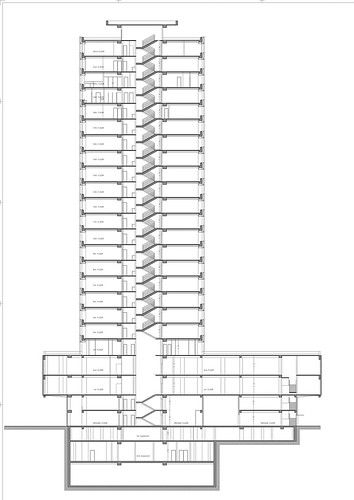
The challenge for this design was to reinterpret this short history with an architecture that would treat the existing tower as a monument or as an idiosyncratic ruin. From the other side, an inhabitable interior office space was prescribed by the program of the competition.


A presentation of cancellation may rule the treatment of the modern ruin. A design based on reuse of existing structure with existing local waste materials proposes a pervert recycling of the cancellation principle. The reflection for another version of a Tower in the port, should conclude at a prematurely ruined, unfinished but hospitable building. A particular sophisticated scenography would need to present an inhabited modern ruin more than a symbol of power. A partial presentation of its beautiful derelict structure oriented the elaboration of its facade.

Transparent Cells and Flying Trees
Ethel Baraona Pohl posted the Transparent Cells in ArchDaily. The project was published in 2009 from TU Delft and it concerns the design for a New School of Architecture after the old Jacob Berend Bakema's building was burnt. The building interprets visually an invisible network of people communicating through the Internet. It concerns a new school of Architecture and its form is given to the invisible social student life by the placing of independent glass units in an elevation that serves as an interface or as a simple presentation screen. The main elevation is meant to function as web site, where we see users online. Things changed radically in the conditions of a university studio of architecture during the nineties.
The big amphitheatric studio of Harvard's GSD, could represent a structure embodying one of the more spectacular possible frames for an architecture workshop in the early past.
(Harvard GSD, from yan da's flickr box)
Such a concept for a studio has no real practical value today. The conditions of sitting and working on architectural drawings are different. A studio today is a space of mediated communication through existing invisible networks. The networks are present and the communities are formed in flexible ways without that we see them.
The studio was performed as a table work, now it is a work done through screenings. The student works are operations done in front of screens; the works do not differ so much from normal office works as was the case in the past. The network circulation of drawings and photos is more quick and efficient than the traditional public presentation of them. The school works as a tv channel or a newspaper; it has to follow the media rationale: work to be produced in order to be seen and criticized by a community that is not necessarily found inside the school. This condition needs other conditions of sharing that depend more to a net strategy than to a communal space syntax. Communities are formed in an abstract space and the dialogue is to be performed in sophisticated Internet platforms.


concrete beds revisited

The Concrete Beds project is found again in an interesting book by Mona Mahal and Asli Serbest, published by Gerd de Bruyn for Institut Grundlagen moderner Architektur und Entwerfen (IGMA), Universität Stuttgart. The work is presented within an analysis of the concept of speculation and some of its histories in Architecture.
This 2004 project proposes prefabricated beds of reinforced concrete to be planted in a rocky seaside landscape in such a way that they look like scattered caves. Wires and tubes are hidden in the "natural" ground not to disturb an imagery of "semi-natural" life in caves while constituting all the benefits of a hidden infrastructure.
How Architecture learned to Speculate is a limited edition.


ladders, slides and horizontal bars for a roof field
An installation of a large number of ladders, slides and horizontal bars in selected Athenian center blocks. The added metallic objects are supposed to be placed by artisans working in Athens without general or detailed architectonic plans: the description for the execution of the construction would be the only design; an indication of the connection points and the type of each connection is what replaces here the architectural drawings. The program could conclude with bridging different city blocks through suspension bridges.
View of Athens from above: the urban landscape hides its upper field and its contact with the sky.


waste design strategies

Positive and negative re-use.
dpr-Barcelona published last week the waste design project. The challenge was to re-use construction waste in order to built new "buildings". The waste is used in its most "clear" form: in this work the waste can be read either as a series of finds or as a mass. A combination of these two understandings of waste form the design mechanism of this offices "waste tower". A mass of waste is shaped for its main building. Some old big recipients are chosen to organize a green elevation.
We can argue that the reinterpretation of a find is a positive reconstruction of it. We reorganize a strategy for an object while we re-invent a possible re-constitution of it. In a second productive mode the object was deluded in a volume of mixed recycled mass.

The proposed building can be used as a particular office complex. It is constituted by 3 different distinct volumes: the first is a scaffold designed as a staircase and corridor structure that is linked to the second volume through some light bridges. The second volume negotiates the idea of negative design in the particular case of an installation that receives in its interior old used kegs. The third is a proposed structure that could be named floating garden and may be seen as another tactic for reuse of tanks, stabilizing them through strong and thin titanium beams and columns in order to create a vertical garden.

the flickr set on the project
the singer and the armchair

A new "double" novel written in Greek and published by ΕΚΔΟΣΕΙΣ ΑΓΡΑ in Athens. The story can be projected to the changes of a single room that changes shape and content when different furniture are moved in or out. Plans of the 4 versions of the room are included. The cover maybe represents a fifth version of the room idealized. Ἡ Τραγουδίστρια καὶ ἡ πολυθρόνα. * ** *** **** *****


